

Driving Economic Growth
Our goal shouldn’t simply be more businesses. It is a stronger local economy where small businesses thrive, commercial corridors are clean, green, and welcoming, residents have access to opportunity, and government works as a partner rather than an obstacle to growth.
Columbia Heights has always been a neighborhood of entrepreneurs — immigrant families, legacy small businesses, artists, retailers, restaurateurs, and vendors who have created economic vitality with limited resources. We are the “city within a city,” and we need the District government and community-based organizations to do their part by removing barriers, enforcing the rules fairly, and creating the conditions for people and businesses that want to invest here to truly succeed.
The Problem
The local economy is under pressure from three directions at once. First, regional economic change is reducing the customers many neighborhood businesses depend on. Fewer federal workers, more remote and hybrid work, uncertain commercial real estate values, and changing consumer behavior all mean fewer people are commuting, shopping, and spending locally. And still, a restaurant owner on 11th Street does not need an economic forecast to understand what a slower Thursday night means for their bottom line.
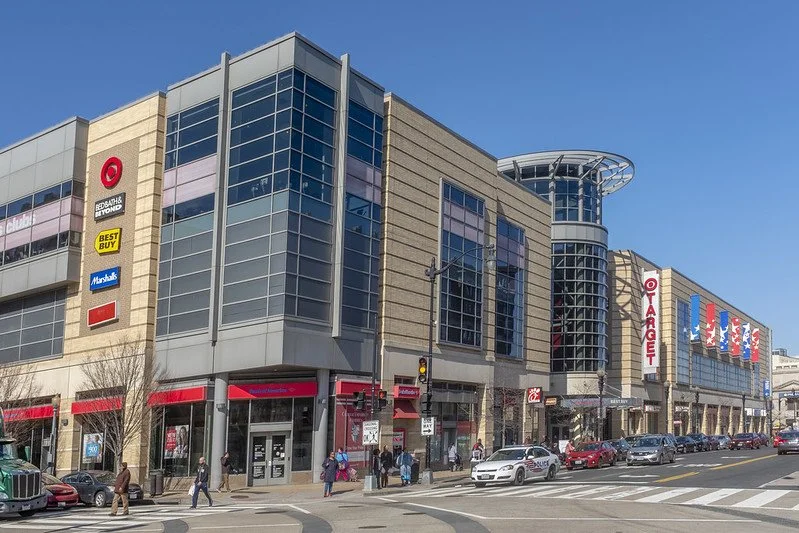
Second, structural change was realized across major retailers and big-box stores. Roughly 300 U.S. chains announced store closures in 2026 alone — our own CVS on 14th Street closed, albeit for several other reasons as well. DC USA, which opened in 2008 as a big-box, park-once retail shopping destination, is now 20 years old and has an aging shopping model. So, it is not hard to imagine what could happen if a national anchor like Target were to leave — it is one of the highest-grossing on the East Coast, so hard to see, but not impossible. And we are not planning for what happens if the major retail market continues to contract and vacancies remain unfilled.
Third — and perhaps the most compelling — is the District’s government regulatory failure. In 2023, the Council passed the Street Vendor Advancement Act to fix street vending in Columbia Heights and the District. It decriminalized vending (which it should have done!), created an amnesty program for vendors with outstanding debts (again, necessary!), directed agencies to process various new licenses and permits, including for food handling, and established a Columbia Heights and Mount Pleasant Vending Zone to be run by a contracted vending zone manager. It could have been a good law had the foreseeable consequences been addressed with affected stakeholders. Nearly two years after the law took effect, only three vendors had been licensed under it. Finger-pointing has some saying this is the fault of the Mayor and her administration; others, including some agencies, say vendors don’t want to get licensed and comply with the law’s requirements.
Compounding all this are the equally chaotic transportation challenges posed by idling and double-parked for-hire vehicles, including the mopeds, and short-term visitors overstaying the allotted time in pick-up-drop-off (PUDO) areas. This creates unnecessary bottlenecks at the blocks in front of DC USA, contributing to an already strained corridor for bike lane access, priority bus lanes, and designated for-hire PUDOs. The Department of For-Hire Vehicles (DHFV) is not doing enough to enforce regulations on taxis, rideshares, and mopeds; the latter are regulated as for-hire vehicles following Council action in 2024. The idling vehicles slow down buses that are likely behind schedule; moped operators sit halfway into the street blocking traffic, sometimes barely avoiding a collision with a car or bus; and cyclists are lucky if the lane is clear of vendors’ debris, or don’t collide with a person, car, or bus trying to get to and fro. The situation is untenable and directly impacts businesses along this corridor.
All that said, the point is not that Columbia Heights needs an entirely new economic development strategy to attract and retain business — though we do need to think strategically about how we can grow over the next 5-10 years. The fastest and most efficient tool available to our neighborhood right now is to ensure that the laws already on the books, including those governing street vending, are rigorously enforced. And while that work is unglamorous, it requires somebody to keep score and call out the Executive to enforce the law and the Council to understand the impact of its policy choices and decisions. That is precisely what an ANC commissioner is for, and what Anthony has been doing for years.
Zoom In: What is Anthony doing for 1A06
Anthony has been singularly focused on ensuring that the District creates an environment that allows Columbia Heights’ local economy to grow and thrive in ways that truly benefit residents and businesses. He has emphasized that specific policy choices have had the opposite effect of spurring growth and attracting and retaining businesses. That is why Anthony has called for, and joined District agencies and officials on corridor walks along 14th Street to show firsthand the challenges our neighborhood economy is facing. He’s joined the Deputy Mayor for Planning and Economic Development, the Director of the Department of Small and Local Business Development, and others at the table to discuss issues related to Main Street funding and performance tracking, pushing for more resources and better metrics to measure impact. He’s also focused on working with the Ward 1 Clean Team and other partners to ensure that Civic Plaza and other key areas of the public realm on 14th Street are inviting, so visitors want to return and prospective investors and business owners want to set up shop in our neighborhood. And Anthony has fought for the policy environment that attracts and retains businesses and keeps our public spaces welcoming and inviting for residents and visitors alike, so they want to shop, eat, and live in Columbia Heights.
Our solutions
1. Demand that the Council provide a real, comprehensive fix to street vending. Anthony has long demanded that the street vending framework be adjusted, especially because the 2023 law was crafted with little to no engagement with those it would affect, including the vendors themselves. Brick-and-mortar businesses and residents were not consulted, and neither saw an incentive to testify at the time because they knew their views would be ignored. That must change. Anthony will continue to call on every member of the Council to visit Columbia Heights and see the effect of their votes — they have to see it for themselves to know what needs to be fixed. Anthony will also continue to call for reconsideration of the vending zone’s boundaries and the vending site plan submitted by the former Vending Zone Manager, which was not developed in consultation with businesses and residents—the Commission had only an opportunity to comment on the final draft. We need a framework that works, and Anthony has put forward recommendations for one that the Council must consider.
2. Create a vacancy-to-storefront pipeline that includes robust enforcement. Holding a storefront empty should cost more than filling it. Anthony has called for and will continue to urge he development of a public, address-level inventory of vacant ground-floor commercial space on the 11th and 14th Street corridors, including owner of record, tax class, and days vacant, paired with a request for coordinated Department of Buildings (DOB) and Office of Tax and Revenue (OTR) enforcement of vacant and blighted property designations and the higher Class 3 and Class 4 tax rates that attach to them. Anthony will also urge DOB to enforce regulations requiring individuals and developers with construction permits to complete their work within a specified timeframe so the activity doesn’t impede corridor activation — simply paying taxes on a vacant lot or dilapidated building shouldn’t be a pass.
3. Fight for expanded funding opportunities to support our small businesses. If our businesses are our tax base — and the engine of our local neighborhood economies — we need to treat them like it. We must create the conditions that attract and retain all types of businesses, allowing them to grow and thrive. Anthony will continue to fight for increased funding for the Ward 1 Clean Team, funded through the Department of Small and Local Business Development (DSLBD), so they can maximize their staffing capacity and resources to keep up with the traffic passing through our neighborhood (their service area is large compared to their budget). Anthony will also push for Columbia Heights to be among the first neighborhoods to see new litter containers piloted or procured by the Department of Public Works (DPW), and to build out Adopt-A-Block opportunities for businesses to invest in the public realm, including maintained tree boxes/wells; and increased funding for façade improvements, particularly for legacy small businesses. A grimy, littered corridor is a drag on every business along it, so Anthony is focused on improving the conditions in our public realm that enable businesses to attract customers, stay active and welcoming, and thrive as they are meant to.
4. Convene direct conversations about the changing retail landscape and impacts on DC USA now. Anthony has leaned into the need to understand and challenge assumptions about Columbia Heights’ economy. He has called on the Executive to think more strategically about how they prepare for and respond to changes in retailer and consumer behaviors and trends. So, Anthony will continue to focus on how we have the conversation about DC USA's next twenty years before it is forced on us — building on the Executive's work to develop a new retail action strategy for the District's major commercial centers. This work also feeds into the Comprehensive Plan rewrite, which means we need to rethink commercial land use and how we might incentivize or modify mixed-use corridors. And with the impending sale of DC USA, we have an opportunity with a new owner to transform this retail complex.
5. Use the ANC’s District budget and financial plan input to defend small business investments and push for oversight. Anthony paid close attention to how District dollars are being spent, from Main Streets and Clean Teams, DSLBD technical assistance and grants to larger public realm investments. Anthony will continue to spotlight neighborhood-level oversight of community-based organizations receiving District funding under these programs, such as the Columbia Heights-Mount Pleasant Main Street. Anthony will continue to make the case, through written comments to the Council and the Executive, in every budget cycle, for the specific programs our corridors depend on and need. Anthony will not stop fighting for the resources our small businesses need to grow and thrive, and that our neighborhood economy is set up for success.