

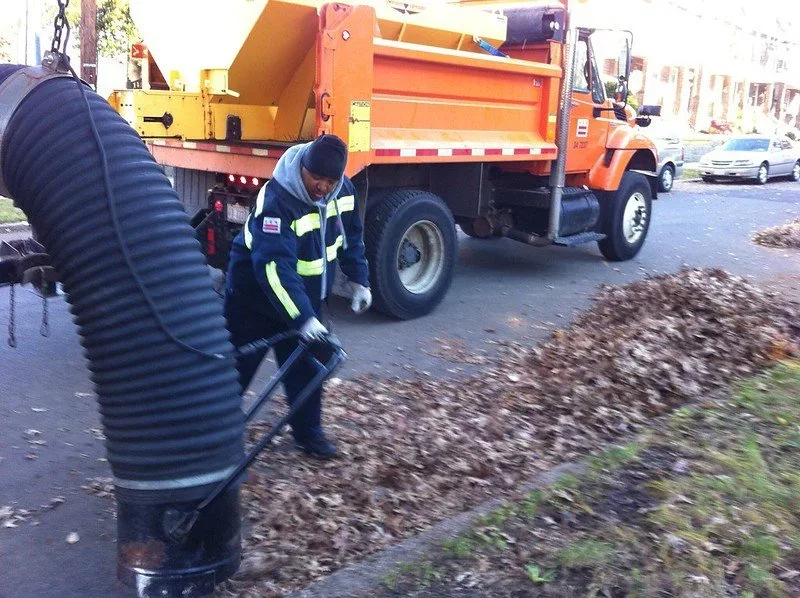
Improving Core City Services
Every household in Columbia Heights pays for a city that works. That is why Anthony has been hyper-focused on whether the trash gets collected on time, the rats are gone, the streetlight is on, the sidewalk is walkable, and the 311 ticket actually closes the problem instead of just closing the ticket.
The Problem
Let’s start with rats, because every resident usually does. The DC Department of Health (DC Health) reports responding to more than 5,000 rodent complaints since January 2026 and treating nearly 10,000 burrows, with a 99.9% resolution rate. Hold that number next to what came out of a Council hearing in July 2026, where it was revealed that the District's rodent figures are likely "way off," and that whole sections of the city are not even on DC Health’s radar as problem areas. One councilmember put the underlying issue precisely — a resident reporting a sighting and a resident reporting a burrow are describing wildly different numbers of rats, and 311 does not distinguish between them. In other words, we’ve got to be smarter about where to tackle this issue — and fast — because the rats are getting smarter at evading traps, identifying food and water sources, and occupying all available spaces as a safe harbor to mate and breed.
Now, let's talk about the trash — the source of the rats more often than not. It’s very reasonable to assume that Columbia Heights generates more waste per linear block than any other neighborhood across Ward 1, because we have density, shared alleys, food-serving establishments, and the busiest pedestrian corridor in Ward 1 (and likely many areas of DC). The Containing Litter and Ensuring Adequate Neighborhood Collections Amendment Act of 2024, implemented through the Fiscal Year 2026 budget, directs DPW to install public litter containers on residential blocks. Whether that actually reaches our blocks, at the right scale, with a collection schedule that keeps them from becoming rat feeders, is an open question that needs to be addressed.
And the problem isn't just rats or overflowing trash cans. It's insufficient or missed street cleaning, broken sidewalks and crosswalks, graffiti on facades and alleyways, abandoned shopping carts on residential streets, illegal dumping in the public right-of-way, dead trees or no tree canopy at all, malfunctioning streetlights or misaligned pedestrian crossing signals, or 311 requests that seem to disappear into a bureaucratic black hole. These are the symptoms of a severely broken government, one that seems to be incapable of solving even basic problems with a $22 billion budget. The Executive seems too busy measuring performance activity (and just barely doing so) rather than delivering results with real impact — impact that can be felt at the block, street, and neighborhood levels.
For years, Columbia Heights residents have been told that services are improving because response times are shorter, more tickets are closed, or agencies are meeting internal performance targets. Yet, Columbia Heights residents experience something entirely different in their daily lives. They report the same pothole multiple times. The same alley fills with uncollected trash or recyclables week after week. A streetlight is “repaired” only to fail again. Illegal dumping returns within days of being cleared. Graffiti is removed from one wall while another sits untouched for months. Problems are addressed individually rather than comprehensively. And then the more meaningful questions are almost never asked: Did the problem we solved stay fixed? If it didn’t, what is the larger contributing factor that also needs to be fixed? This distinction matters because Columbia Heights is unlike almost any other neighborhood in the District. Residents spend more time reporting problems than enjoying their neighborhood. Businesses absorb the costs of neglected public spaces that discourage potential customers from visiting their restaurants or shops. Volunteers organize cleanups to perform work that government should already be doing. This is not how effective local government should function.
Then we get to the issue of the money necessary to solve these and other problems. The District closed a projected $1.1 billion Fiscal Year 2027 shortfall substantially through program reductions. The challenge will only become greater in the years ahead. The District faces sustained fiscal pressure as the federal workforce shrinks, commercial property values remain uncertain, and budget growth slows, and with it, the revenues that drive our city forward. Agencies will be asked to accomplish more with fewer resources, both federal and local dollars. That sobering and eye-widening reality makes accountability even more important. Service levels may be significantly affected. And these service-level changes or disruptions are not usually announced — they show up as a consolidated route, a crew not backfilled, a contract not renewed, a pilot program not extended. Agencies will be asked to accomplish more with fewer resources, both federal and local dollars. That sobering and eye-widening reality makes accountability even more important.
Columbia Heights deserves a government that measures success the same way residents do: cleaner, safer streets; greener, more welcoming public spaces; reliable, well-maintained infrastructure; responsive, proactive agencies; and problems that are solved the right way the first time.
Zoom In: What Anthony Can Do for 1A06
Columbia Heights is filled with dense housing, shared alleys, restaurants, nightlife, schools, the Metro, public plazas, street vendors, and one of Ward 1’s busiest commercial corridors, all concentrated in a small area. Yet too often, the District and its partners provide service as though every block has the same needs.
An ANC’s core responsibility is to monitor complaints from residents in its neighborhood commission area regarding the delivery of District government services and to file comments on them with the appropriate District government entity and the Council. So, we do have a statutory role in holding agencies accountable for delivering on the basics and performing at a level sufficient to our neighborhood’s needs.
If re-elected, Anthony will continue to fight for agency results that are responsive to residents’ complaints, and for their performance to be scrutinized and reported on to ensure they maximize resources and address underlying problems. He will press agencies to explain their service levels, or lack thereof, and show the underlying data, identify responsible staff, and respond in writing to explain when the neighborhood’s needs are not being met.
Anthony will continue to demand real progress on longstanding issues, such as addressing the rat problem plaguing our district, because a family shouldn’t have to look at the same burrow in their yard or see holes in their trash bins. Anthony will continue to fight to ensure the District gets the basics right.
Our Solutions
1. Urging the Executive to get the basics right by working with ANCs. Anthony knows that almost every 311 request originating in an ANC or single-member district can often be pinpointed by a Commissioner to a contributing factor. That is precisely why ANCs were established and statutorily constructed over time. We can, and should, connect the dots to issues related to 311 requests, and often we have solutions that the Executive is not clearly addressing. This is why Anthony worked to pass resolutions that call on the Executive to rethink how executive departments, agencies, and offices engage ANC at the ward/service level. Anthony knows that you can’t negotiate with an agency unless you know where they are starting from on an issue or how they view a problem. The only way to have a real conversation about the facts and data is to be at the table with them during service-level planning and problem-solving, and Anthony will continue to push for that.
2. Push for Columbia Heights to receive more robust rodent treatment, and overhaul the petition process. Anthony has made solving the rodent problem in our district and community one of his top priorities. Anthony will continue to work with DC Health to combat the problem head-on, including extending pilot programs into the 14th and 11th Street corridors and the alleys behind them. He is working with DC Rat Rangers and other groups to identify a wide range of effective, reliable solutions. Anthony is also focused on ensuring the rat treatment petition process is overhauled, streamlined, and accelerated so that digital tools can be scaled more effectively and responses can be processed and delivered more quickly for treatment.
3. Push the Department of Public Works on the 2024 litter container law. Specifically, Anthony will focus on how the agency integrates this law’s implementation into existing Open Data DC litter can mapping. He will ensure that any ANC comments developed in response to any notices under the law to the ANC are accompanied by an assessment of whether the litter can actually accommodates the demand and whether it will be provided with a lid to discourage dumping. Anthony will also continue to push DPW to improve baseline trash collection and, in areas like Columbia Heights, establish an enhanced service-level agreement.
4. Conduct consolidated walk audits each month for district-level improvements. Anthony currently conducts block-by-block walks of every street in 1A06 twice a month to identify infrastructure improvement needs — streetlight outages and dark spots, broken sidewalks, missing or non-compliant curb ramps, cracked or faded crosswalks, damaged signs, overgrown tree boxes/wells. He will continue to do this, generating a single consolidated work order with the Mayor’s Office on Community Relations and Services on a quarterly basis, building on 311 requests that may have been unaddressed or underaddressed. Anthony has also done this for neighborhood-wide improvements in his role as chairperson of the Permanent Special Committee on Public Life and Neighborhood Planning.
5. Advocate for budget accountability based on agency performance and neighborhood feedback. Anthony has long viewed the ANCs’ role in the District’s budget process as important — and often underappreciated and untapped. Anthony will continue to press for more deliberative engagement in the budget formulation process with a specific, itemized ask list for operating and capital improvements backed up by data — DPW sanitation and litter collection routes, DC Health Rodent and Vector Control, DPR facility maintenance, DGS custodial and grounds contracts, DDOT streetlight and sidewalk capital improvements — followed by the same during the budget consideration process at the Council. Residents deserve more of a say in the District’s budget process, and Anthony is committed to using his voice and vote to make sure they have one.
6. Fully close the 311 service loop. Anthony is committed to taking a more involved role in ensuring that 311 service requests are actually met with real follow-up — and ensuring that agencies do the same. Anthony regularly walks the entire district 1A06, sometimes hitting all the streets on a single walk a few days a week. This allows him to spot-check for issues and see whether a persistent issue with a 311 request has been addressed. Anthony will continue to ensure that agency responses to service requests are clear, regularly updated with case statuses, and at close-out, state precisely what was done to address the underlying problem or request.