

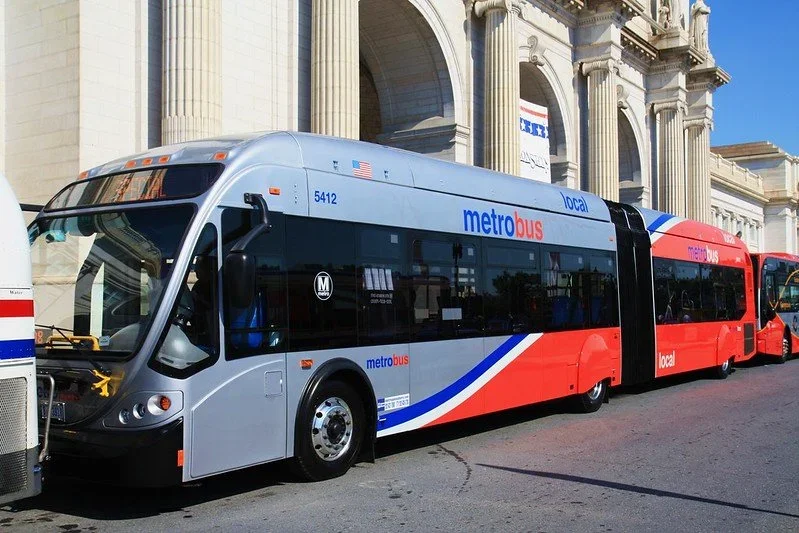
Safe, Accessible, and Reliable Transportation
In Columbia Heights, the bus is not an amenity — it is how this neighborhood gets to work. I will fight for a corridor where the bus beats the car, where crossing 14th Street is not a calculated risk, and where no child's walk to school is the most dangerous part of their day.
Safe, reliable, and accessible transportation is a fundamental right for every resident. The District must invest substantially in its transportation infrastructure to build a system that is both reliable and efficient. Too often, local funding fails to reach the projects that repair, maintain, and expand our roads, streets, and public transit quickly enough - just think about the conditions of crosswalks in Columbia Heights. Modernizing our infrastructure and stepping up enforcement will improve safety, ease congestion, and shorten travel times—while ensuring that our broader multimodal strategy is deliberately planned as we install priority bus and bike lanes and expand support for other micromobility options.
The problem
A year after WMATA rebuilt its entire bus network, the buses are slower, and fewer people are riding them. Since the Better Bus redesign launched in July 2025, ridership has declined by about 7 percent. Average monthly bus speed fell from 9.8 to 9.3 miles per hour. Weekday morning rush hour speeds have declined steadily — 8.4 miles per hour in May 2024, 7.6 in May 2025, 7.4 in May 2026. On-time reliability is at a three-year high and still only 76.5 percent. Some of the redesign genuinely worked: the busiest routes gained frequency, more residents live near twelve-minute service, and it was accomplished without increasing the operating budget. But the headline outcome is a slower bus.
And Columbia Heights is where the reason is proven. The D74 on Columbia Road NW nearly doubled its speed — from 3.4 to 6.4 miles per hour — on the single stretch that received bus priority treatment. The route average stayed stuck around 6, because the treatment does not run the length of the route. Buses on 16th Street, where there are lanes, are about 6 percent faster. Buses on H and I Streets, which have lanes, gained about 4 percent. An independent analysis of fourteen American bus network redesigns found only two produced faster buses afterward — and both of those cities added dedicated lanes or transit signal priority at the same time. Every redesign without them got slower.
This is not a mystery. It is a policy choice the District keeps declining to make. The entire region has roughly 14 miles of red bus-only lanes, remarkably few for a network this size, and nothing physically prevents a driver from parking in one — cameras logged about 75,000 blocked-lane citations this year. The K Street transitway, a stated premise of the Better Bus plan, stalled. The streetcar shut down in March 2026. Metro's own general manager has said publicly that the region has little dedicated roadway and that the agency is at its mercy, and that Metro is now willing to build lanes itself and absorb the political heat rather than keep waiting on the city.
Underneath that sits a demand problem the District did not cause and cannot ignore: regional travel is down about 2.5 percent, Metrorail still carries over 100,000 fewer daily riders than in 2019, and the region has lost roughly 100,000 jobs. And one cause is specific to this neighborhood. The executive director of the Coalition for Smarter Growth attributed part of the ridership loss to the crackdown on immigrant communities — that many residents may not be taking transit right now for safety reasons. When people stop riding the bus because they are afraid of who is standing at the bus stop, that is not a transportation statistic. It is a civil rights problem showing up in a ridership report.
Then there is the street itself. A large share of households here do not own a car. The Metro entrance is at 14th and Irving, in the middle of the busiest pedestrian corridor in Ward 1, feeding directly into the plaza, the vending zone, and the DC USA frontage. Crossing 14th Street on foot, with a stroller, with a cane, or as a nine-year-old, is a daily negotiation with drivers who are not slowing down. That is the ground truth this section is about.
“We already ran the experiment. On the one block of Columbia Road where the District actually gave the bus its own space, the bus nearly doubled its speed. Everywhere else, it slowed down. My neighbors do not need another network map — they need paint, cameras, and signal priority along the entire route in this budget cycle. A bus stuck in traffic is a tax on the people with the least ability to pay it: the woman working a shift she cannot be late for, the student, the senior, the family without a car. Every minute we leave on the table, we take out of their day.”
Our solutions
1. Finish the bus priority treatment end-to-end on Columbia Road and 14th Street. A formal Commission resolution to DDOT and WMATA requesting continuous dedicated lanes, transit signal priority, queue jumps, floating bus islands, and all-door boarding on these corridors — with the D74 speed data as the argument, because it is the District's own evidence. Request that DDOT publish its promised post-redesign bus lane plan with dates attached, and that these corridors appear in it.
2. Enforce the lanes we already have. Expanded bus-lane and bus-stop camera enforcement on 14th and 16th Streets, with revenue dedicated to transit and safety capital rather than disappearing into the general fund. A bus lane that is legally reserved and physically available to anyone is a stripe of paint, not an intervention.
3. Fix the pedestrian environment at 14th and Irving and the corners around it. Leading pedestrian intervals at every signalized intersection in the corridor; daylighting at every corner so drivers can see people before they enter the crosswalk; raised crosswalks at Irving, Park, and Monroe; curb extensions to shorten crossings; and an honest DDOT and WMATA assessment of whether the Metro entrance plaza is designed for the pedestrian volume it actually carries. I do not believe it is.
4. Vision Zero where children walk. Safe Routes to School audits and actual physical treatments — not signage alone — for the Harriet Tubman Elementary, Bruce-Monroe, and Cardozo walksheds. Slow zones on residential side streets, hardened centerlines to stop the left-turn crashes that injure pedestrians most often, and speed cushions where warranted.
5. Full implementation of the STEER Act. Press DDOT and DMV to implement the 2024 STEER Act's accountability provisions for repeat dangerous drivers — speed limiters for the worst offenders, booting and towing of vehicles carrying large unpaid ticket balances, and out-of-state plate accountability. Automated enforcement without collection is theater, and every resident who has watched the same car speed past the same camera for a year already knows it.
6. A bike and micromobility network with an actual spine. Protected lanes that connect to something rather than ending at an intersection; secure bike parking and corrals at the Metro entrance and DC USA; marked dockless scooter corrals to clear the sidewalks for people using wheelchairs and walkers; and Capital Bikeshare station density and rebalancing that reflects how heavily this corridor uses the system.
7. Annual written WMATA service review before the Commission. Headways, reliability, crowding, stop conditions, and route performance for every line serving 1A06, presented in writing and in public — with a specific push for restoration where the redesign cost this neighborhood connectivity, and support for the frequency expansions in the "visionary" network. Metro has been responsive when asked precisely; it cannot answer a complaint that arrives as a feeling.
8. Accessibility as a floor, not an upgrade. Audit every bus stop in this district for shelter, seating, lighting, real-time arrival information, and an ADA-compliant landing pad; inventory every curb ramp and get the non-compliant ones scheduled. For a senior or a wheelchair user, an unshaded pole in the sun is not a bus stop.
9. Make the bus stop safe to stand at. A Commission resolution seeking clear, published, multilingual assurance that WMATA and MPD will not facilitate civil immigration enforcement at bus stops and Metro entrances. Ridership recovery and civil liberties point the same direction here, and there is no version of a functioning transit system in this neighborhood that runs on fear.