

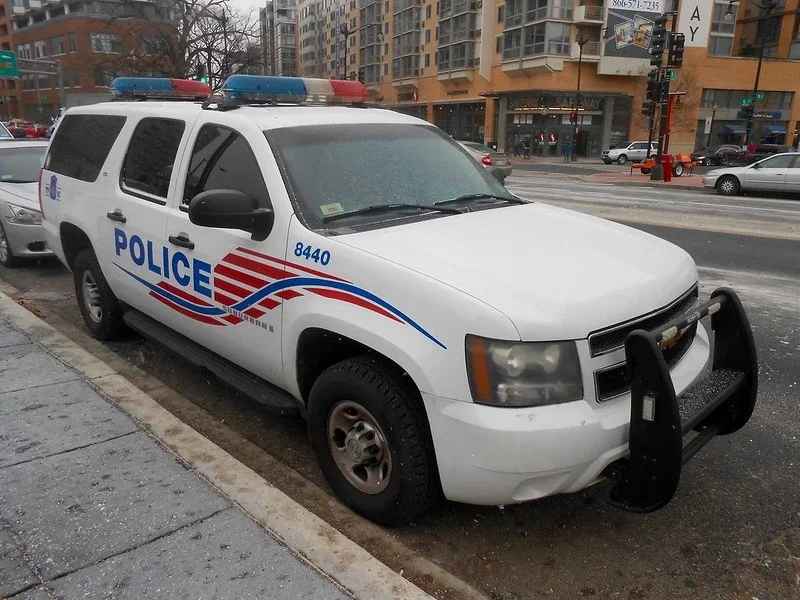
Building safer communities for all
Public safety is much more than crime reduction. It means order, opportunity, trust, accountability, and well-managed public spaces.
Rather than viewing policing, public health, economic development, planning, transportation, and neighborhood stewardship as separate issues, Anthony’s approach recognizes their interconnectedness. A safer Columbia Heights will be achieved not through any single agency or initiative, but through sustained, measurable coordination across government and the neighborhood, backed by robust oversight and a commitment to restoring confidence in the police-community relationship built on dignity and respect. Anthony is fighting to build a public safety system that answers to the people who live here and earns the trust of the people that it is meant to serve.
The Problem
Much of the public debate over crime in the District presents a false choice. It asks residents to believe either that the city is becoming dramatically safer because of falling crime statistics or that policing is broken and failing our communities. Both narratives miss the reality experienced in Columbia Heights. Citywide, the data are encouraging. Violent crime has declined significantly. Robberies are down approximately one-quarter, homicides have fallen substantially, and assaults with dangerous weapons continue to decrease. The data have shown that the District's homicide rate may reach its lowest level in more than 25 years. Those accomplishments reflect real work by officers, prosecutors, violence interruption organizations, community partners, and residents who refused to accept the violence that defined previous years.
And yet, a citywide average is not a neighborhood statistic. On February 13, 2026, Third District officers responded to a shooting outside a gas station in the 2600 block of 14th Street NW; a 22-year-old man died of his injuries. On March 1, 2026, officers responded to a shooting in the 1300 block of Columbia Road NW; in April, a 15-year-old was arrested and charged with assault with a dangerous weapon in connection with it. On September 25, 2026, a homicide occurred in 1A06. Those are not statistics to the people who live around or near those blocks. They are a reminder of a neighborhood facing serious public safety and policing challenges.
Columbia Heights' safety problem is concentrated, place-based, and only partly about violent crime. Just as much of it is chronic disorder in a very small footprint — the Civic Plaza, the Metro plazas, and areas along Columbia Road, Park Road, and Irving Street — where a combination of crew violence, public alcohol consumption, drug sales and use, and the absence of any consistent presence of officers walking the beat or behavioral health outreach workers doing their jobs combine into a place residents and visitors alike avoid, to be candid.
Layered on top of that is something new and genuinely destabilizing. Since August 2025, when the Metropolitan Police Department was federalized by the President, our city and neighborhood have lived with a sustained aftermath of what many call a military occupation. More than 2,400 federalized National Guard troops have been stationed in the District — with tens of them patrolling our streets daily — and their deployment has been extended into January 2029. Federal immigration enforcement with ICE has expanded alongside it, threatening the livelihoods of our immigrant neighbors and their families, and putting citizens in harm’s way, too. None of this has made us safer — or achieved the backward aims of this current presidential administration.
In a ward that is roughly 19% Hispanic, and a neighborhood with one of the largest Central American communities in the entire region, the effect is measurable and corrosive. Advocates report residents avoiding public transit out of fear. When people are afraid of the government, they do not call 911, they do not attend meetings or testify, and they do not identify the person who shot at their neighbor. Community policing is not a slogan or token idea; it is a fundamental contract for neighborhood safety that has yet to be rewritten. It depends on residents believing that the officer who takes the report is not the same one who will later that day detain their brother or cousin alongside a federal immigration officer. That belief is being spent down faster than anyone — namely the Mayor and Chief of Police — is replacing it.
So Columbia Heights is experiencing two failures simultaneously: an underresponse to chronic, place-based disorder and issues, and an overresponse, not all of the District’s own making, that severs the trust every effective policing and violence prevention strategy depends on. That is why Anthony has dedicated so much to addressing these issues and identifying solutions to specific problems, ensuring we can return to a safe and just community for all.
Zoom In: What is Anthony Doing for 1A06
An ANC cannot control the deployment of police officers or direct MPD’s policies. But it does have a statutory responsibility—and meaningful leverage—to make MPD, the Deputy Mayor for Public Safety and Justice, Deputy Mayor for Health and Human Services (DMHHS), the Department of Behavioral Health (DBH), and other agencies answer to the people most affected by our chronic public safety challenges and failures.
If re-elected, Anthony will continue to use his office to organize residents’ concerns into clear, actionable demands to MPD, the Mayor, the Council, and District agencies. He will insist on regular agency briefings and public accountability for public safety and behavioral health conditions in District 1A06 and across our neighborhood. Anthony introduced and got unanimously approved by the Commission several public safety measures that deal with improving outcomes in Columbia Heights: (1) R25-45, A Resolution Concerning Policing, Security, and Neighborhood Safety in Columbia Heights, and (2) R26-243, A Resolution Concerning Neighborhood Input For Community Safety Programs and Grant Awards in ANC1A and Ward 1.
Anthony will continue to:
Demand place-specific data and response plans for persistent hot spots, including at and around the Civic Plaza, the Metro plazas, and other key areas across the neighborhood.
Regularly request that MPD, behavioral health service providers, and violence-interruption organizations appear at open public meetings to account for their performance.
Press agencies, such as DBH and the Office of Neighborhood Safety and Engagement, to notify and meaningfully consult the ANC before making decisions on service delivery changes and on the issuance of grants to organizations that affect Columbia Heights.
Make sure that residents’ complaints about public safety and other chronic issues are documented, escalated, and followed through on with written responses from the Executive.
ANCs are not helpless to address these issues. Anthony’s commitment is to use every tool at the ANC’s disposal to make Columbia Heights safer and to build trust in the police among the people who call it home.
Our Solutions
Anthony is keenly focused on advancing public safety through community-oriented policing strategies that build trust and collaboration between residents and law enforcement. These strategies ensure we get back to the basics and provide the safe communities that all residents, families, businesses, and visitors deserve. And to do that, at least in the short term, we have to sufficiently call out and address the chronic neighborhood disorder that seems to converge at a handful of hot spots across central Columbia Heights. We must also address the broader erosion of community trust in public government institutions, such as the MPD and even the ANC. Addressing only one while ignoring the other will not produce a safer neighborhood.
Anthony supports violence interruption programs and will fight for increased funding for community-based organizations working daily to reduce crime across Columbia Heights and the District. However, Anthony has called out the lack of performance metrics or data showing that these programs are actually making a difference in our neighborhood. He will continue to work with his colleagues to push for a whole-of-government approach to reducing crime, supporting victims and survivors, and ensuring perpetrators of violent crime are quickly arrested and prosecuted.
Anthony also recognizes that diversion and other alternatives to incarceration are a necessity in some cases, so he will work to promote policies that address the root causes of violent crime and other illegal behavior, such as food and housing insecurity, joblessness, lack of educational resources, and unmet mental health needs. We can and must recognize that public safety is more than crime reduction. It is the confidence that a parent has walking their child to school, that a shift worker has leaving their job after dark, that a senior has using public transit, that a small business owner has opening their doors each morning and closing up at night, and that every resident—regardless of race, ethnicity, spoken language, immigration status, or income—can call for help knowing they will be treated with dignity and respect. We can build a better future towards this goal, and Anthony has a plan to get us there.
1. Require better place-based strategies and accountability from MPD. Anthony has called on, and will continue to urge, the Chief of Police and MPD’s Third District (and the Fourth District for the limited service area crossover) to provide a standing quarterly hot-spot review covering major response areas. Anthony has made clear that this shouldn’t be a passing appearance at a Commission Meeting or during a community safety walk but rather a written, publicly available report to the Commission with incident counts by type and location, calls for service, clearance rates, and the named PSA personnel available to answer questions on the record about the incident. Anthony will continue to press for greater neighborhood- and district-level oversight of MPD and its approaches to community policing and keeping crime down.
2. Demand MPD officers get out of their cars and back on the beat. Officers cannot build trust through a car window. Anthony has called for, and will continue to press for, specific commitments to provide dedicated foot and bike patrols across the neighborhood, particularly along the 14th Street corridor between Park Road and Monroe Street and along the 11th Street commercial strip. Anthony has called on MPD to strategically place QR codes — like the ones inside 7/11 and other businesses — at locations across the neighborhood so officers have to scan them to document their presence and show they have walked a particular beat. Anthony will continue fighting for this.
3. Build a trust firewall for our immigrant neighbors. Columbia Heights is a neighborhood of Black and brown people, citizens and immigrants alike. And we know these neighbors, their children and family members, because we work alongside them or see them on walks around our communities. We can and will protect them from inhumane abuse and capture by federal immigration officials. Anthony will fight to ensure our sanctuary values are respected and protected, and that our immigrant neighbors know we have their backs and won’t give up on helping them through this challenging time in our local and national story of struggle — we will fight, and Anthony won’t back down.
4. Bring rigorous oversight to violence interruption programs and funding decisions. Violence interruption works when it is sufficiently staffed, supervised, and present, period. Anthony supports these programs only if they are held accountable for actually performing in ways that demonstrate a real reduction in violence. Anthony will continue to insist on knowing whether that is meaningfully happening in Columbia Heights. Any District-funded community-based organization operating in ANC 1A should routinely appear before the Commission with a service area map, a list of contacts made, mediation counts, staffing levels, and monthly/quarterly outcome data, projected and met. This is what Anthony has called for, and will demand going forward. His position is clear: public money demands measurable performance and results, and if organizations can’t deliver or be transparent about where they've fallen short, they don’t deserve to work in our communities.
5. Demand the behavioral health service capacity the neighborhood needs. The District needs citywide stabilization and sobering capacity, and I will not pretend otherwise. However, my objection to the facility planned at 1338 Park Road NW has always been the siting and the process, not the expected service. Anthony’s conditions for its location there have been specific and negotiable: a binding community operating agreement enforceable through the Commission; a defined plan for discharging residents to a day center or next step in their recovery; and a standing community advisory role, separate from the ANC. Anything less is failing the communities most impacted and does little to meet the needs of the people it’s intended to serve. Anthony will continue to call for the coordinated deployment of resources to address the mental health and drug abuse crisis unfolding in central Columbia Heights, and urge the Department of Behavioral Health to provide greater supervision of grantee organizations doing outreach work on the ground.
6. Continue to organize monthly community safety walks and quarterly public safety talkbacks. Anthony has regularly coordinated with MPD and agency partners to organize community safety walks that help build residents’ trust in the officers who serve on our blocks and corridors and provide an opportunity for feedback on what’s working and what’s not. Anthony is committed to continuing these walks — and building in additional quarterly talkbacks — to ensure we hold MPD leadership accountable for our communities’ concerns about the places and spaces where incidents are occurring across Columbia Heights.